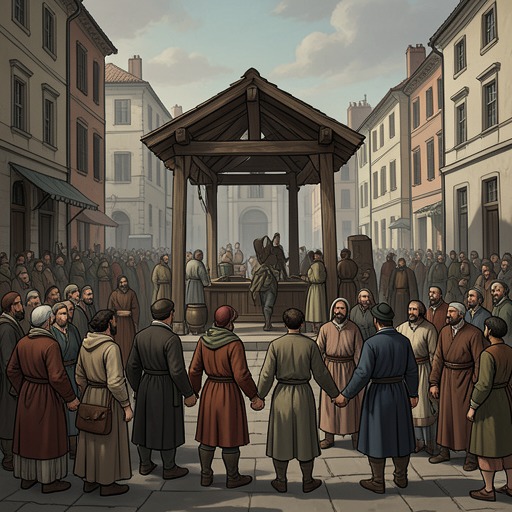
Non-representation of Sovereignty
The Social ContractNon-representation of Sovereignty holds that the people cannot delegate their sovereign will to elected deputies. Because sovereignty consists in the general will, only the people themselves can make laws; deputies may act as stewards but cannot give laws definitive force. The principle distinguishes popular legislation from executive administration and makes citizens’ direct authority over law the measure of political freedom.
The Basis of the Principle
The rule follows from Jean-Jacques Rousseau’s account of legitimate political association. The social contract must join people in a common force capable of protecting each associate’s person and goods, while allowing each, in uniting with all, to remain free and obey himself alone. Political authority is legitimate not simply because a government exists or has prevailed: actual facts cannot by themselves establish a right. The question is how common power can be reconciled with freedom, and the answer depends on the people retaining sovereignty.
That sovereignty cannot be represented because it lies in the general will, and will cannot be transferred through an intermediary without becoming another will. A deputy’s decision, even if made in the people’s name, is not identical to the people’s own act. Representatives can therefore advise or administer, but they cannot substitute their judgment for popular ratification and thereby create binding law.
Legislation and Execution
The principle does not rule out every form of representation. Rousseau separates the legislative power, which expresses the general will, from executive power, which supplies the force needed to give law effect. The people cannot be represented in the act of legislation; the executive, by contrast, can and should be represented because its task is to apply rather than originate the law.
This distinction also clarifies the status of the Roman tribunes. Their office did not give them executive power, and they could not rightfully represent the Roman people by virtue of their own authority. When they acted as though they could exercise the people’s powers, they were usurping functions associated with the senate, rather than performing a legitimate delegation of popular sovereignty. The example makes the point institutional: an office’s name or public standing does not authorize it to replace the people’s legislative act.
Assemblies and Popular Ratification
Rousseau contrasts modern representative arrangements with ancient practices of popular assembly. In Greece, the people assembled in public and performed for themselves the political tasks that concerned them. The arrangement depended on particular conditions: a mild climate, limited material needs, and slave labor that left citizens time for public affairs. In Rome, popular participation could be logistically difficult; during the time of the Gracchi, some citizens had to cast their votes from rooftops. Yet inconvenience did not, in Rousseau’s account, justify handing the sovereign power to representatives.
His judgment of modern representative government is correspondingly severe. The people of England may regard themselves as free, but Rousseau argues that their freedom lasts only while they elect members of Parliament. Once the election is over, the people have no direct legislative authority, and the deputies’ decisions cannot count as laws unless the people personally ratify them. Any law not so ratified is null and void—not a law in the full sense.
Political Freedom and Its Limits
Rousseau recognizes that direct popular sovereignty is difficult to preserve in large states. He doubts that a sovereign people can continue exercising its rights unless the city is very small, while immediately raising the apparent danger that a small city could be conquered. He leaves the resolution for a later discussion, pointing toward a possible combination of the external strength of a great people with the convenient polity and good order of a small state.
The principle’s consequence is nevertheless categorical: once a people allows itself to be represented in the exercise of sovereignty, it is no longer free in Rousseau’s political sense. This claim does not endorse slavery or treat it as legitimate. Rousseau discusses the ancient dependence on enslaved labor to explain the material differences between ancient assemblies and modern societies, then explicitly rejects the right of slavery. The distinction matters: the historical conditions that made some forms of civic participation possible do not supply a moral justification for coercion.
Non-representation thus sets a demanding standard for political freedom. Public authority can be exercised in the people’s name only when its legislative decisions remain the people’s own, while delegated officials are confined to executing law. Where that boundary collapses and government usurps sovereignty, the social compact is broken: citizens recover their natural liberty and are compelled, but no longer bound, to obey.